
Bringing a U.S.-spec car into Germany can feel intimidating. This guide shows the TÜV path in plain English—what gets checked, where U.S. cars differ, how to prepare without stress, and what it may cost. We provide support and guidance only; no legal or technical guarantees.
What TÜV checks and how U.S. cars differ
- Safety inspection (HU): Brakes, suspension, steering, lights, tires, body, VIN.
- Emissions (AU): OBD readiness, tailpipe test where applicable, visual checks of emission controls.
- Where U.S. cars differ:
- Headlights: Must have an E‑marked beam pattern or be replaced with EU‑approved headlights.
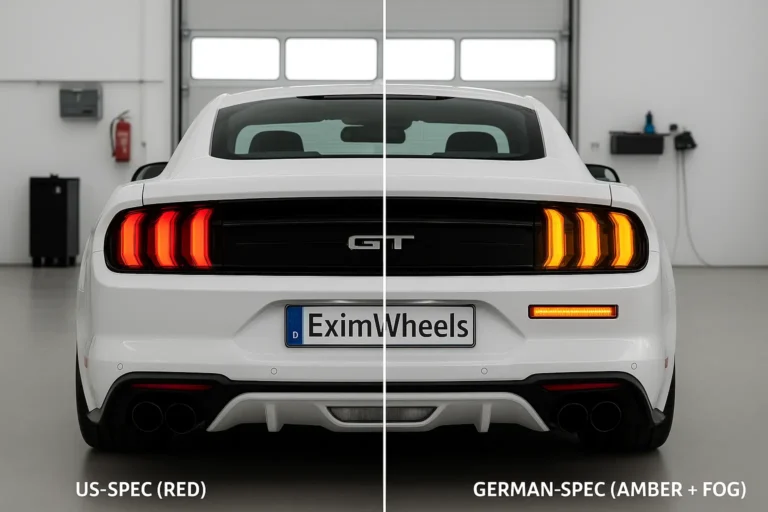
If no EU‑approved alternative exists, an exemption must be obtained from the relevant authority (depends on the federal state). - Rear turn indicators: Must flash amber, not red. They must be separate from the brake lights.
- Reverse lights: The white reverse light must be located on the right side or on both sides of the rear of the vehicle. (Required by ECE R23; right side ensures visibility to traffic when reversing.)
- Rear fog light: Required on the driver’s side (left) or in the center (Mandatory under ECE R38; must not be on the right side.)
- Speedometer: Must clearly display km/h. A dual scale (mph + km/h) is acceptable.
- Reflectors: Must be present in the rear section of the vehicle and must be E‑marked.
- Side turn indicators: Must be located on the mirrors or on the front fenders near the wheel arches. (Required by ECE R48 for visibility from the side.)
- Headlights: Must have an E‑marked beam pattern or be replaced with EU‑approved headlights.
- Homologation note: In Germany, individual approval (Einzelabnahme) may be needed if no EU documentation exists; this is often referred to as “homologation” for imports.
- Exhaust / noise: Aftermarket exhaust systems often fail inspection if they are too loud or not approved according to EU regulations.
Documents to prepare before your TÜV visit
- Identity: Passport/ID, proof of address in Germany (Meldebestätigung).
- Vehicle: U.S. title, bill of sale, VIN photos.
- Import: Customs clearance and tax proof.
- Insurance: eVB number (electronic confirmation).
- Technical data: Any COC or data sheet if available; if not, expect an individual approval path.
- Tip: Keep printed and digital copies. Label files by category.
Quick pre-check you can do at home
- Lights and signals: Low/high beam aim, E-marks, amber rear indicators, functioning rear fog light, working DRLs and brake lights.
- Instruments and warnings: Speedometer shows km/h, no active warning lights (ABS, airbag, CEL, TPMS).
- Brakes and tires: Even braking, sufficient pad/disc life, correct tire size, load and speed rating.
- Leaks and wear: No visible oil/coolant leaks; shocks and bushings not excessively worn.
- Exhaust and emissions: Stock or approved exhaust; OBD shows readiness where applicable.
On the day of TÜV and what happens next
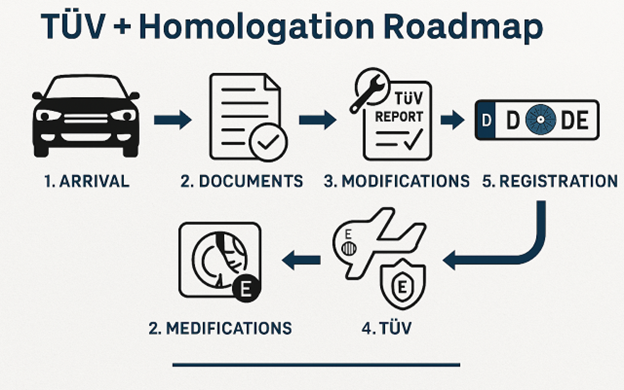
- At the station: Identity check, visual inspection, brake test, lights and chassis check, OBD/emissions, documentation review.
- Outcomes:
- Pass: You receive the report to proceed with registration.
- Minor issues: Fix and return for re-check within the stated window.
- Missing EU data: You may be directed to individual approval (Einzelabnahme).
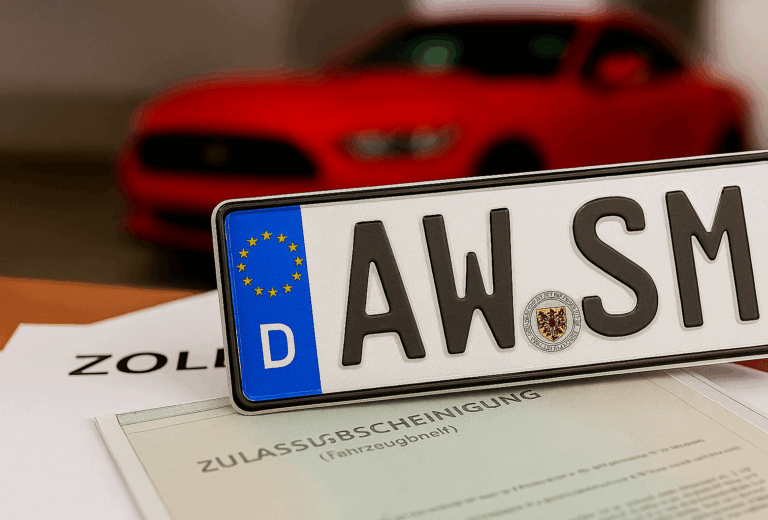
- After TÜV: Go to the registration office (Zulassungsstelle) with your documents and TÜV report to receive plates and registration certificates (Teil I & II).
Costs to budget
There is no single fixed price. Fees depend on your city’s schedule, the scope of modifications, and even subjective TÜV engineer decisions. Here are approximate ranges you may encounter:
- TÜV inspection (HU + AU): €150 – €250
- Registration office fee (Zulassungsstelle): €40 – €80
- License plates issuance: €30 – €40
- Certificate of Conformity (CоC) or individual approval (Einzelabnahme): €250 – €420
- Vehicle modifications (lights, speedo conversion, exhaust, reflectors): €0 – €3000+
Typical total for a U.S. import falls between €550 and €2500, but can climb toward €4000+ if extensive engineering work or multiple re-checks are required. Always clarify costs up front with your TÜV station and any third-party specialists—you may see slight fee variations from one region to another.
Homologation for imported cars in simple terms
- What it means: Proving your car complies with the technical and safety standards required for German roads when standard EU documents are missing (often called “homologation”).
- When it applies: Common for non-EU models and U.S. market cars without EU type approval.
- What to expect: Technical data verification, possible part replacements, and an individual inspection path.
Need help?
Fill the form below or simply text us