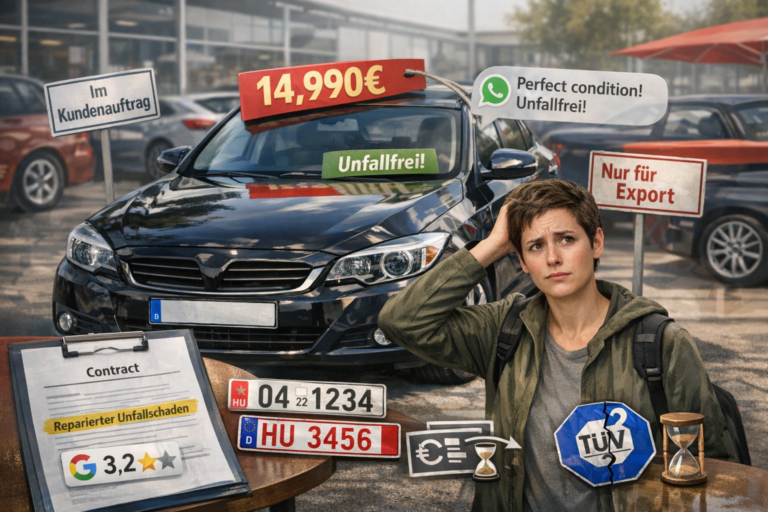
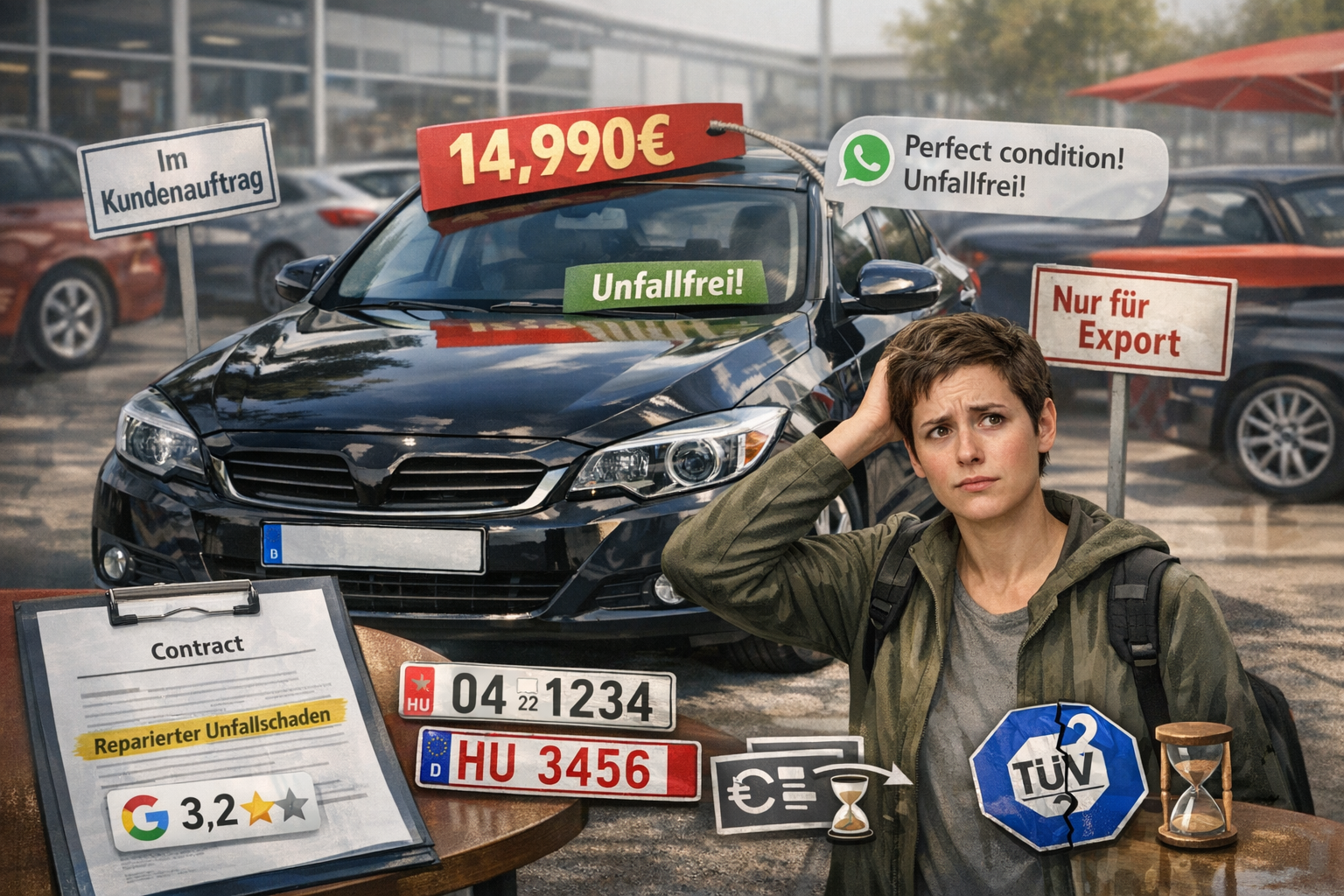
Popular platforms like Mobile.de, mandatory technical inspections (TÜV), and the legally mandated requirement for car dealers to provide a one-year warranty on sold cars often create a strong illusion of safety. It seems easy: choose a car, transfer the funds, and drive away. However, expat forums are flooded with stories about hidden fees, voided warranties, and frozen bank transfers.
To successfully avoid problems buying a car in Germany, you must understand one thing: this is not just shopping; it is a strict legal process. A lack of local knowledge exposes new arrivals to severe expat car buying risks. In this guide, we break down the 9 most expensive mistakes expats make and share insider rules to protect your money, time, and mobility.
Mistake 1: Buying “Im Kundenauftrag” or “Nur für Export”
Many foreigners know that a commercial car dealer in Germany is legally required to provide a 1-year warranty on used cars (Sachmängelhaftung). Knowing this, buyers relax, feeling fully protected. And this is exactly where unscrupulous sellers use a legal loophole.
To avoid warranty obligations, a dealer might sell the vehicle “Im Kundenauftrag” (on behalf of a client) or label it “Nur für Export / Gewerbe” (only for export or B2B).
The Risk: You are buying a car on a nice lot from a professional, but legally, the deal is framed as a private, consumer-to-consumer sale. If the day after the purchase your car requires expensive repairs, it will be entirely your financial problem.
How to Avoid It: Carefully read the purchase agreement (Kaufvertrag). If the dealer refuses to act as the official seller and doesn’t provide a warranty, walk away.
Mistake 2: Trusting Chats Over Contracts (The “Unfallfrei” Illusion)
The seller swears on WhatsApp that the car is in perfect condition, and the listing proudly says “Unfallfrei” (accident-free).
The Catch: In German law, “Unfallfrei” has strict boundaries. Minor damages, repainted bumpers, or glass replaced through insurance (Bagatellschäden) often don’t count as accidents. Furthermore, in Germany, verbal promises, emails, or messenger chats hold zero legal weight.
The Risk: If the final official contract (Kaufvertrag) has a small-print note about damages (e.g., Reparierter Unfallschaden), it will be impossible to prove in court that “they promised otherwise on WhatsApp.”
How to Avoid It: Only the contract is legally binding. Scrutinize every single clause before signing.
Mistake 3: Ignoring Reviews and Cheap Warranties
Even official dealerships can have bad apples. Shady sellers often lure you in with a “super deal,” do zero pre-sale preparation, and simply buy a cheap third-party engine and gearbox insurance policy (for around €500-€600).
If a major breakdown occurs that isn’t covered by this cheap policy, the dealer has the right to simply cancel the deal (Rücktritt vom Kaufvertrag). You must return the car, and they refund your money. But if you bought the car in Berlin and broke down in Düsseldorf, you will have to pay for the tow truck across the country out of your own pocket. It is not uncommon that this money is not returned voluntarily, and you have to get it back through the courts.
Insider Rule for Evaluating Dealers on Google Maps:
- Under 50 reviews (especially 5-10): Treat this as a low rating. There is a high risk of post-sale problems.
- Under 3.5 stars: Close the listing immediately. High risk of losing money and time. It is highly likely not worth it.
- 3.5 to 4.2 stars: Risky zone. If the car is unique, you can buy it, but only after a strict inspection by professional independent inspectors before transferring funds. A mandatory check of all documents, a fresh TÜV, and a thorough contract review before the deal are absolute musts.
- 4.5 stars and up (with 50+ reviews): Reliable sellers. They value their reputation and don’t sell questionable cars. In this case, a visual check via our Remote 4K Video Inspection module might be enough to assess the body and interior.
Ready to start the search?
Mistake 4: Trying to Register Without a Permanent Address
To follow the standard vehicle registration procedure in Germany, you need an official local address.
The Risk: The widespread problem in Germany is simply finding permanent housing, which is a struggle not just for expats but for everyone. You might arrive and live in a hotel or a Booking/Airbnb apartment for months, where getting a local registration certificate (Meldebescheinigung) is physically impossible. As a result, your car is paid for but sits idle on the dealer’s lot.
The Solution: If you haven’t secured permanent housing through relocation agencies yet, but absolutely need your mobility from your first days here—our service is exactly for you. We legally bypass this gap.
Mistake 5: Using Transit Plates and Voiding Your Warranty
Trying to bypass the lack of an address (Mistake #4), buyers often resort to temporary solutions: getting yellow plates (Kurzzeitkennzeichen — valid for 5 days) or red export plates (Ausfuhrkennzeichen).
The Risk: Once the dealer sees that you are requesting export plates or registering the car to a third party, they can legally void the voluntary dealer warranty, as the car is technically leaving the jurisdiction or breaking the ownership chain.
The Solution: For our clients, we use a fully compliant legal procedure called Zulassung mit Empfangsbevollmächtigtem (Registration via Authorized Recipient in the Heinsberg district). You are the first and direct buyer from the car dealer, the car is registered entirely in your name, and you receive permanent German plates. This means your dealer warranty is 100% preserved.
Mistake 6: Hidden “Expat Fees” from Middlemen
When looking to buy a car in Germany for expats, many relocation agencies offer “turnkey” packages with one massive lump-sum price, hiding the actual breakdown of costs.
The Solution: Only work with providers who offer a Transparent Pricing Policy. Our service charges a fixed flat fee for our modular work, while all third-party government fees and insurance premiums are paid strictly based on the original receipts—without a single cent of markup.
The Risk: These packages often hide a 200-300% markup on mandatory insurance, registration office (Zulassungsstelle) fees, and vehicle taxes. Middlemen simply prey on your lack of local pricing knowledge.
Mistake 7: Buying US Military Cars Without Factoring in Homologation
On the German market (especially near bases like Ramstein or Stuttgart), you can find attractively priced US-spec vehicles sold by American military personnel.
The Catch: These cars are driven in Germany under a special SOFA status, which exempts them from strict European standards and the German TÜV. An ordinary expat does not have this status.
The Risk: You won’t be able to drive it legally. You will have to pay thousands of euros for expensive conversions (lights, exhaust, software) and pass a complex §21 full inspection (Vollgutachten).
The Solution: Carefully weigh the feasibility of such deals. You can read more in our article: 5 Biggest Mistakes When Registering a US Car in Germany – How to Avoid Them. If you still decide to go for this type of vehicle, we offer looking into our TÜV Ready service to handle the homologation process for you.
Mistake 8: Rushing and Underestimating Bank Transfer Delays
A seller might pressure you: “Pay today, or someone else is taking it tomorrow.”
The Catch: Paying a large sum in cash (over €10,000) is almost impossible at dealerships due to strict anti-money laundering laws (Geldwäschegesetz). Furthermore, large international SWIFT transfers often trigger compliance checks at your bank.
The Risk: The bank may request contracts and proof of funds, and the transaction will drag on from a few days to a couple of weeks. The dealer won’t wait and will cancel the reservation, or the car purchase will only happen after your arrival. You’ll be forced to be a pedestrian or use expensive taxis and rentals, even though you had every chance to use your own car from day one.
The Solution: Factor in the time needed for remote car sourcing in Germany and bank clearances. We can register and deliver the car to you 2-3 days before your arrival, but it’s better to purchase it a month in advance. Most dealers will hold the car on their lot for 2-4 weeks before registration. However, you shouldn’t register it 4 weeks early, as you’ll be paying insurance and vehicle tax for that entire month. The golden rule: we buy weeks before arrival, and register days before.
Mistake 9: Having No Backup Plan for Sudden Breakdowns
No one is immune to mechanical failures. There are real cases where a brand-new car from an official dealer went into “limp mode” after just 20 kilometers due to an electronics failure.
The Risk: Suddenly finding yourself stranded on the Autobahn with your family and luggage, or being left without a car for a month while the dealer waits for a warranty part.
The Solution: Consider adding a Schutzbrief (a highly affordable roadside assistance add-on to your car insurance) or getting an ADAC Plus membership if staying mobile is critical for you.
Pro Tip: If your car needs to stay at the dealership for weeks for a warranty repair, look into long-term mobility solutions. In Germany, Auto-Abo (car subscription services) are very popular, allowing you to rent a car for 1-3 months without long-term leasing commitments, perfectly bridging the repair gap.
Conclusion: No Stress. Just Drive.
Buying a car in Germany is a complex process. To ensure your purchase brings you joy rather than headaches, remember these 3 golden rules:
Timeline: Start the process 8 weeks in advance. Good deals happen, but not every day, and banking compliance takes time.
Trust, but Verify: Evaluate dealers using our grading system (4.5+ stars and 50+ reviews). Demand an independent inspection or a detailed 4K video, and always check for a fresh technical inspection (TÜV / HU).
Contract is King: Only trust what is written in the official purchase agreement.
Have questions or need help?
Eliminate the stress, language barriers, and hidden fees of a turnkey car purchase in Germany.
📞 [Call us] or
and your verified, officially registered car will be waiting for you right at the airport gate.